Monday, May 21, 2018
Take the DHS Challenge
Do you pay attention to your surroundings? And more importantly, what would you do if you saw something suspicious? The Department of Homeland Security (DHS) (along with other agencies) uses the "See Something - Say Something" campaign to encourage people to report suspicious activity to their local police departments and to their state Fusion Centers.
Check out these DHS videos and test your observational skills.
TeenSafe App Exposes Your Child's Information to On-line Predators
But the Los Angeles, Calif.-based company left its servers, hosted on Amazon's cloud, unprotected and accessible by anyone without a password.
The database stores the parent's email address associated with TeenSafe, as well as their corresponding child's Apple ID email address. It also includes the child's device name -- which is often just their name -- and their device's unique identifier. The data contains the plaintext passwords for the child's Apple ID. Because the app requires that two-factor authentication is turned off, a malicious actor viewing this data only needs to use the credentials to break into the child's account to access their personal content data. (ZDNet, May 20, 2018)
District Court Violation Notice (DCVN)
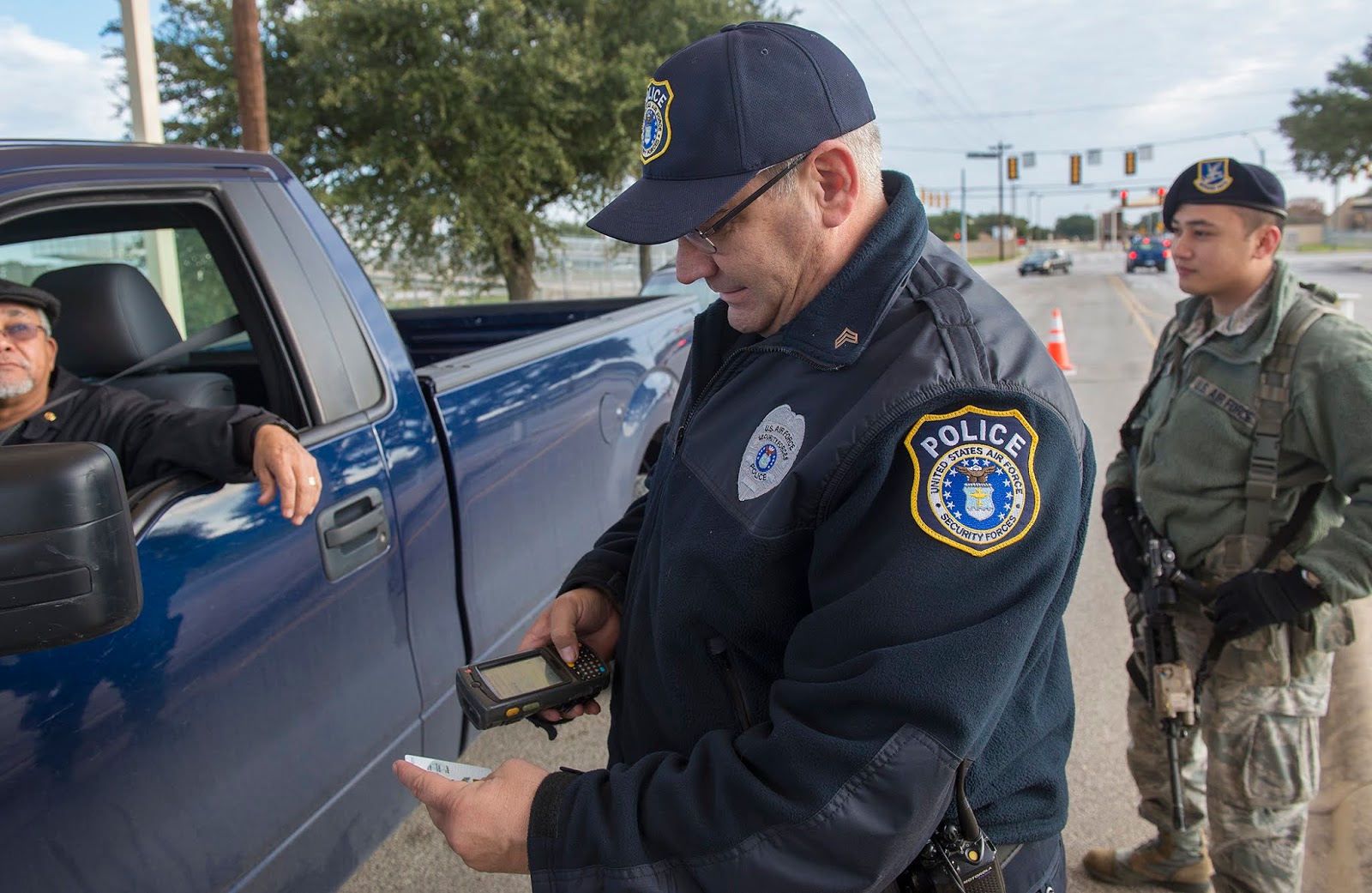
When is a traffic ticket not an ordinary traffic ticket? When the violation occurs on a military base and you are charged with a federal crime. A district court violation notice (DCVN) or "ticket" may be issued by a federal law enforcement officer for violations of certain federal laws and, if occurring on federal property, certain state laws. Violations include improper parking, illegal camping, speeding, civil disturbances, fish and wildlife infractions, and other offenses.
According to 32 CFR 634.32 - Traffic Violation Reports - (a) Most traffic violations occurring on DOD installations (within the United States or its territories) should be referred to the proper U.S. Magistrate.
Note however that, violations are not referred [to the U.S. Magistrate] when "(4) A U.S. Magistrate is available but the accused refuses to consent to the jurisdiction of the court and the U.S. Attorney refuses to process the case before a U.S. District Court."
According to the US Courts web-site: "The Central Violations Bureau (CVB) is a national center charged with processing violation notices (tickets) issued and payments received for petty offenses committed on federal property."
If you choose to contest the DCVN and appear in court, you will initially be scheduled to appear before a U.S. Magistrate.
Once the complaint of information is filed, a date is set for the defendant to appear before the United States Magistrate Judge for arraignment. In cases where an arrest has been made prior to the filing of a complaint or information, the arraignment occurs immediately.
The arraignment before the United States Magistrate Judge is a hearing during which the defendant is informed of his or her rights, advised of the right against self-incrimination, informed about assistance of counsel, notified of his or her right to have the case heard before a United States District Court Judge or before a United States Magistrate Judge, and notified of the dates for further proceedings in the case.
You will be asked to consent to the jurisdiction of the magistrate judge and will be presented with a consent form. You may consent to the jurisdiction of the magistrate judge or you may elect to have your case assigned to a U.S. District Court judge.
Now, in any case before the court you should always consult with legal counsel (an attorney). There are good reasons both to consent to and deny the jurisdiction of the magistrate judge.
In the case of a DCVN issued on a military installation, you may want to have your case heard before a U.S. District Court Judge. The United States Attorney may choose to drop a case rather than proceed before the U.S. District Court, but I think more importantly the District Court Judge will be more likely to consider your case favorably. This is not to say anything negative about the U.S. Magistrate judges - they are certainly very honorable men and women - but they hear the majority of DCVN cases and may be (maybe) more inclined to side with the police officer over the defendant.
The National Motorists Association (NMA) (March 23, 2018) asked: "Did you ever feel that when you received a traffic ticket you were already considered guilty even though under the U.S. Constitution you are innocent until proven guilty? ... Traffic ticket defendants are [treated as if they are] guilty until they prove their innocence, police officer testimony is automatically given more credence than that of ticket recipients, and those same officers are allowed to testify via scripts that have little bearing on reality or facts... But what if you feel you did not violate the law? The NMA always encourages anyone whether they feel they are guilty or not, to FIGHT YOUR TICKET! If just ten percent of all traffic tickets went to trial, the court system would cease to function."
And if just ten percent of all DCVNs were taken to U.S. District Court... ?
Of course, the best way to deal with a DCVN is not to get one in the first place.
Sunday, May 20, 2018
Meet Sunder, a New Way to Share Secrets
The moment a news organization is given access to highly sensitive materials - such as the Panama Papers, the NSA disclosures or the Drone Papers - the journalist and their source may be targeted by state and non-state actors, with the goal of preventing disclosures. How can whistleblowers and news organizations prepare for the worst?
The Freedom of the Press Foundation is requesting public comments and testing of a new open source tool that may help with this and similar use cases: Sunder, a desktop application for dividing access to secret information between multiple participants.
Russian Tor Node Administrator Acquitted of Terrorism Charges
The administrator of an anonymous online network has been acquitted of terrorism charges one year after Russian authorities detained him for allegedly calling for riots on Moscow's Red Square. Dmitry Bogatov, 26, was detained in April 2017 and charged with inciting terrorism in posts online. The math teacher denied writing the posts, adding that anyone could have used his IP address because he hosted a Tor node, which allows other Internet users to surf anonymously through his computer. (Moscow Times)
--
If you run a TOR Node the activities of others may be attributed to you. The EFF states: "Exit relays raise special concerns because the traffic that exits from them can be traced back to the relay's IP address. While we believe that running an exit relay is legal, it is statistically likely that an exit relay will at some point be used for illegal purposes, which may attract the attention of private litigants or law enforcement. An exit relay may forward traffic that is considered unlawful, and that traffic may be attributed to the operator of a relay. If you are not willing to deal with that risk, a bridge or middle relay may be a better fit for you. These relays do not directly forward traffic to the Internet and so can't be easily mistaken for the origin of allegedly unlawful content."
Russian Roskomnadzor Blacklists WhatsApp IP Addresses
According to the Moscow Times (May 17, 2018), Russia’s state media watchdog, Roskomnadzor, briefly blocked the WhatsApp messaging service in what appears to be a continuation of its campaign to block the Telegram application. Users of both WhatsApp and Viber reported accessibility issues in Russia and Central Europe on Thursday afternoon (May 17, 2018). The WhatsApp addresses were removed from Roskomnadzor’s registry of banned sites about a half-hour after the disruption began.
Roskomnadzor is trying to interfere with Telegram’s operations, by blocking IP addresses belonging to Amazon, Google and other popular hosting providers. Many services and online games have been experiencing difficulties because of this. Meanwhile, Telegram has lost just a few percent of its Russian-speaking users in the first month of the ban.
Inside the Massive U.S. 'Border Zone'
Did you know that you can be stopped and searched by the US Border Patrol while traveling from Seattle, WA to Portland, OR?
At its core, the law allows immigration officers to access private lands—except “dwellings”—within the 25 air miles (28.7 miles) of the border. Congress also authorized CBP to set permanent and temporary checkpoints, patrol highways, and board buses, trains, and other vehicles “within a reasonable distance” of the U.S. border, which regulations in 1953 set as “up to a 100 miles.”
CBP can set up checkpoints anywhere it wants within the 100-mile zone and “can temporarily seize all vehicles that drive up to an immigration checkpoint... to conduct an immigration inspection,” a spokesperson said. If they feel they have probable cause, they can search the vehicles. Agents at checkpoints also have wide discretion to pull people aside for a secondary inspection, which could last, per some accounts, for up to 40 minutes.
“It really is kind of a constitution-free zone," says Patrick Eddington, a policy analyst who has been compiling data on border patrol’s internal checkpoints at the CATO Institute, a libertarian think tank. “I guess the best way to phrase it is that in this area, [border patrol agents] are being allowed to nullify people's rights.” (CityLab, May 14, 2018)
Subscribe to:
Posts (Atom)